Anti-theft backpack – what do hidden zippers, RFID, and TSA really provide?
Does an anti-theft backpack really protect against theft?
A business backpack increasingly serves as a mobile office. We carry laptops, tablets, documents, payment cards, keys, and other items that are important both in everyday work and during business trips. In a crowded subway, at a train station, an airport, or on the way to a business meeting, not only comfort matters, but also the way the contents are secured.
That is why an anti-theft backpack is more than just a classic model with extra pockets. Depending on the design, it may use hidden zippers, reinforced zippers, RFID blocking pockets for contactless cards, combination locks, or solutions facilitating luggage inspection during air travel.
However, it is worth knowing that individual security features respond to different threats. A hidden zipper hinders unnoticed access to the compartment, an RFID pocket limits radio communication with a card placed in it, and a TSA lock allows luggage inspection using an appropriate mechanism. None of these solutions in itself guarantees full protection against theft.
The Blueboat offer includes TIGERNU backpacks, including models intended for people traveling, working on the go, and using laptops on a daily basis. As an importer of this brand to the Polish market, we can select products for various business projects, with the possibility of marking the client's logo.
In this guide, we explain how the most important security features work, how they differ from each other, and what to pay attention to when choosing an anti-theft backpack with a company logo.
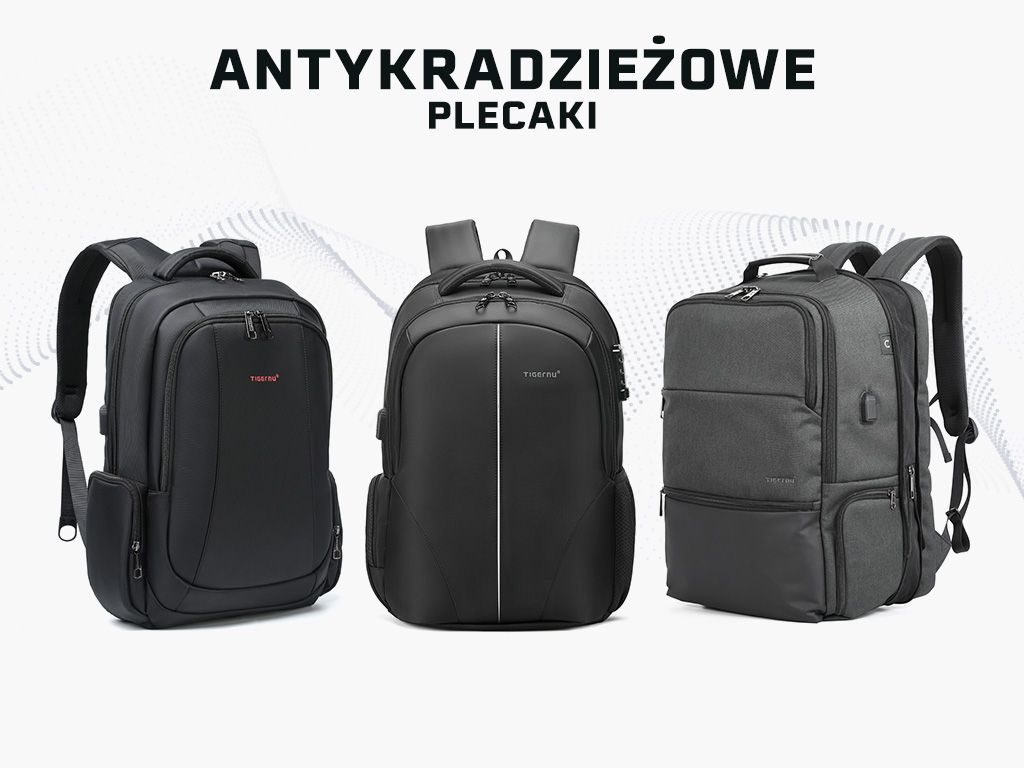
Table of contents
-
What exactly is an anti-theft backpack?
-
Hidden zippers and pockets – how do they hinder access to the contents?
-
Double anti-theft zipper – what does its construction change?
-
RFID pocket – what does it protect and what are its limitations?
-
TSA lock vs. ordinary combination lock – key differences
-
Protecting the laptop and other backpack contents
-
How to match an anti-theft backpack to its application?
-
TIGERNU anti-theft backpacks – examples of solutions
-
Anti-theft backpack with a logo as a B2B gift
-
Summary
-
FAQ - Frequently asked questions about anti-theft backpacks
1. What exactly is an anti-theft backpack?
An anti-theft backpack is a backpack designed in such a way as to hinder unnoticed access to its contents or provide additional protection for specific items. However, there is no single universal feature responsible for all aspects of security.
Depending on the model, the manufacturer can use several solutions simultaneously:
-
hidden zippers and pockets that limit the visibility and accessibility of opening points;
-
reinforced or double zippers designed for greater mechanical resistance;
-
RFID Blocking pockets designed to limit radio communication with compatible contactless cards;
-
combination locks or padlocks that allow locking the zippers;
-
reinforced laptop compartments helping to limit the device's movement and absorb some shocks.
Not all models have every one of these elements. Therefore, when choosing a backpack, it is worth analyzing the specific design, rather than relying solely on the term "anti-theft" in the product name.
It is also important to match the security features to the way it is used. A person commuting to the office every day may primarily need hidden zippers and pockets. For air travel, a TSA lock may be important, while a properly designed RFID pocket will be useful when carrying contactless cards.
2. Hidden zippers and pockets – how do they hinder access to the contents?
One of the characteristic elements of anti-theft backpacks is the modified placement of zippers. In a classic backpack, the main zipper is often easily visible and accessible from the outside. In an anti-theft design, it can be hidden under a material flap or placed by the panel adhering to the user's back.
This solution limits the ability of a person standing behind the backpack's owner to quickly locate and open the compartment.
Hidden main compartment zipper
The zipper can be partially covered with material or routed along the back edge of the backpack. Depending on the design, access to the zipper may be easier for the person taking the backpack off than for someone trying to open it while it is being worn.
This does not mean that the backpack cannot be opened by force or other methods. The security primarily involves hindering unnoticed access and reducing the zipper's visibility.
Hidden back pocket
The second practical solution is a pocket located on the body side. It can hold a wallet, passport, phone, or other small items that the user wants to have access to but simultaneously limit their exposure.
Both the location and the way the pocket is closed matter here. A well-designed compartment remains discreet, and opening it by an outsider is difficult while the backpack is being worn.
When do hidden zippers work best?
Such solutions are particularly useful during:
-
daily commutes on public transport;
-
moving through crowded city centers;
-
traveling by train and plane;
-
participating in trade fairs, conferences, and industry events;
-
transporting a laptop and documents between the office and home.
When choosing, it is worth checking whether the main zipper is hidden or only one of the additional pockets. This is an important distinction, because a hidden pocket does not automatically mean that the entire backpack compartment has an anti-theft design.
3. Double anti-theft zipper – what does its construction change?
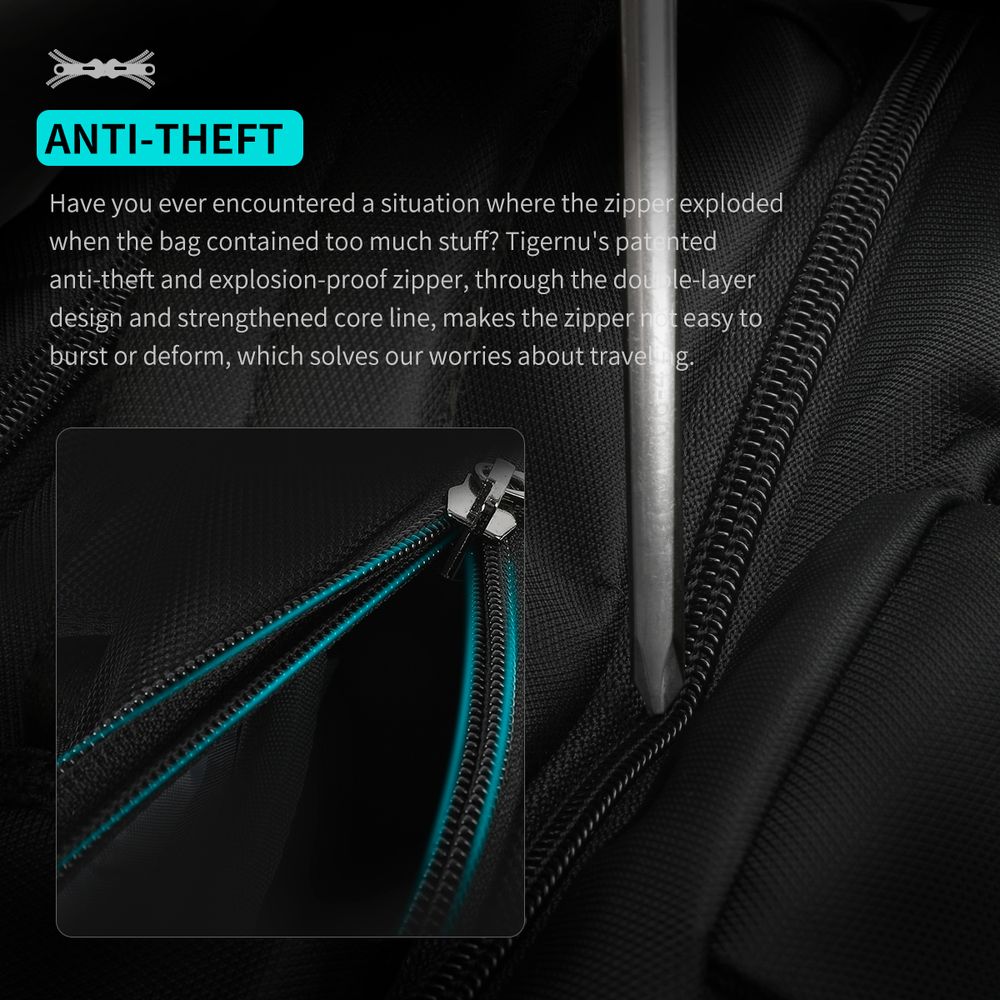
Another solution used in selected TIGERNU backpacks is a double anti-theft zipper, described by the manufacturer as a Double-layer Anti-theft Zipper.
In a classic zipper, the teeth interlock in a single row. In a double design, additional cooperating elements are used, whose task is to increase the zipper's resistance to specific attempts at separation or damage.
This is important because simply securing the sliders with a padlock does not solve all problems related to the zipper's construction. Additional protection can make tampering with the fastener more difficult and increase the mechanical resistance of the entire solution.
What should you check in such a zipper?
Before choosing a backpack, it is worth paying attention to:
-
the design and how the zipper interlocks;
-
the possibility of securing the sliders with a padlock;
-
the way the zipper is covered;
-
the build quality of the sliders and pulls;
-
manufacturer's information about durability tests, if available.
In the case of technical solutions, marketing terms like "anti-theft" or "burst-proof" should not be equated with total immunity to every type of damage. The actual durability depends on the entire construction, material, method of use, and the results of appropriate tests.
An example of a model from the family equipped with a double anti-theft zipper is the TIGERNU T-B3143U 15.6 inch. When selecting a specific variant, it is worth confirming its current specifications and zipper configuration.
4. RFID pocket – what does it protect and what are its limitations?
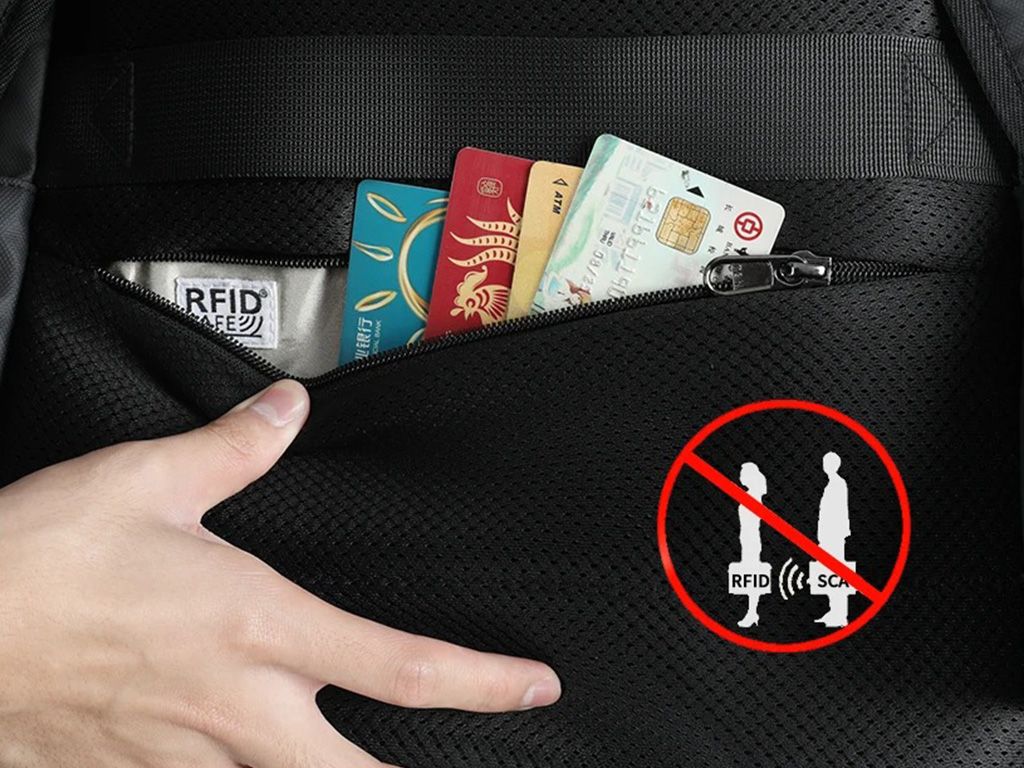
RFID Blocking is a solution meant to limit radio communication between a reader and a card located in an appropriately secured pocket.
RFID, or Radio Frequency Identification, is a technology used in various radio identification applications. Contactless payment cards and some electronic documents use contactless technologies, which is why special shielding layers are used in selected backpacks.
In practice, an RFID pocket can help limit the ability to read the signal from a compatible card placed inside it. However, its effectiveness depends on the construction of the shielding material, the type of card, and its proper placement inside the pocket.
How does an RFID Blocking pocket work?
Material whose properties limit the penetration of specific radio signals is placed in a secured compartment. A card stored in such a pocket is to a greater extent isolated from an external reader.
However, this solution concerns radio communication with the card, and not the overall security of the user's data.
An RFID pocket does not protect against phishing, login data interception, theft of the entire backpack, or every possible type of fraud involving electronic payments.
Where is the RFID pocket located?
The pocket's location matters from the point of view of usability. It can be located inside the backpack, in a dedicated card compartment, or in a separate pocket intended for documents.
It is worth remembering that not every card pocket is an RFID pocket. For example, an external pocket on a shoulder strap, designed for quick scanning of a city card, should allow the card to be read and does not perform the same function as a shielded compartment.
Examples of backpacks with RFID
In the manufacturer's materials, an RFID Blocking pocket was indicated in models such as:
-
TIGERNU T-B3982 – a business and travel backpack with a dedicated internal card pocket featuring an RFID Blocking function;
-
TIGERNU T-B3905 19 inch – a model with a large laptop compartment, in whose specifications the manufacturer also indicates an RFID solution.
Before ordering, you should always check the specifications of the specific product version, because not all TIGERNU backpacks have identical equipment.
More information about the operating principles and various threats related to RFID can be found in studies by the National Institute of Standards and Technology (NIST).
5. TSA lock vs. ordinary combination lock – key differences
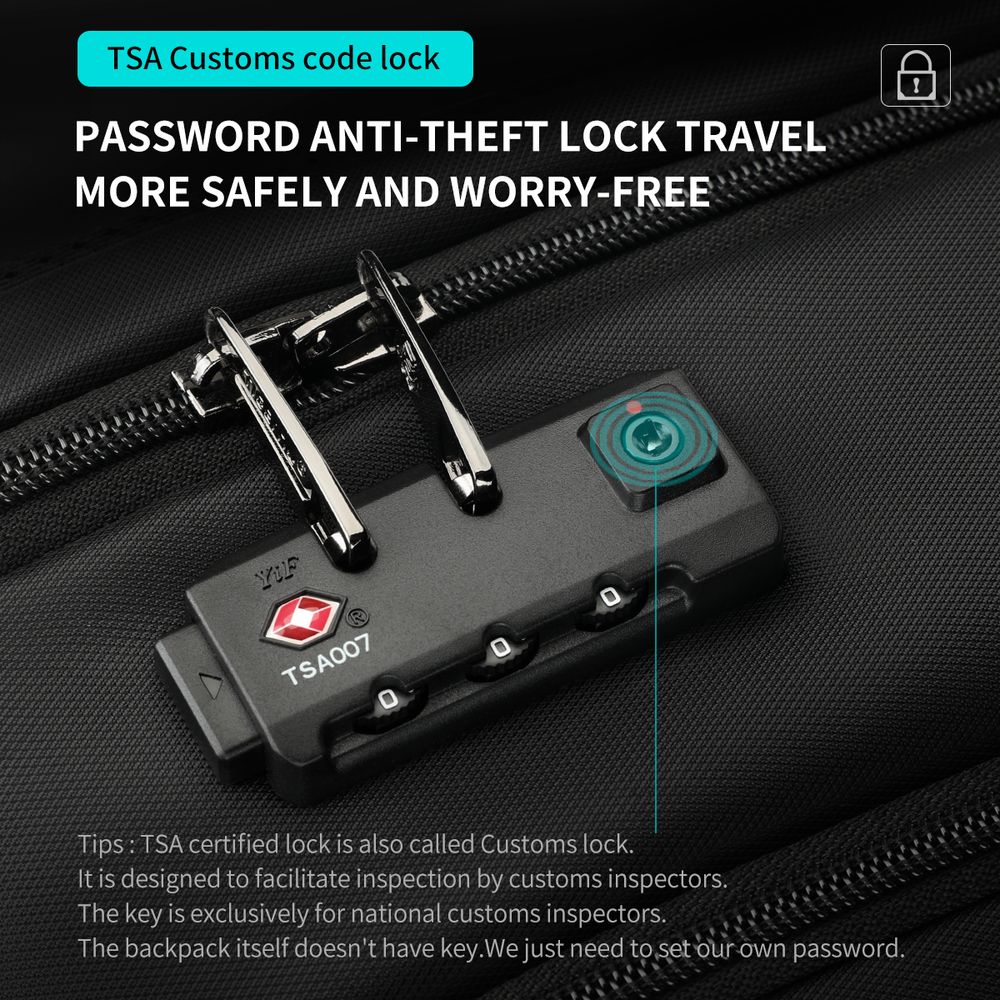
For backpacks intended for business travel, it is worth distinguishing between three solutions: an ordinary padlock securing the zippers, a combination lock, and a TSA-compliant lock.
Ordinary padlock or zipper lock
Its primary task is to limit the ability to freely open the compartment. If the backpack's design has appropriate eyelets near the zippers, they can be secured with a padlock.
Such a solution can increase convenience and hinder accidental or unauthorized opening, but it does not guarantee protection against forceful damage to the backpack.
Combination lock
A combination lock allows the user to set a code that blocks access to the compartment. However, not every combination lock is a TSA lock.
This is an important distinction: the presence of a three-digit code does not automatically mean compliance with solutions used for luggage inspection at airports.
What makes a TSA lock stand out?
A TSA lock is designed to work with a luggage inspection system where authorized officers can open a properly marked lock using a special service key. This allows baggage to be inspected in specific situations without having to destroy the lock.
A description of how such solutions work is presented by the US Transportation Security Administration in the material TSA Recognized Locks.
However, a TSA lock does not mean the luggage is completely theft-proof. Nor does it protect against all damage during transport. Its specific function is to facilitate inspection in systems that support such a solution.
When should you choose a backpack with a TSA lock?
A TSA lock is worth considering if the backpack will be used by people who frequently travel for business, carrying documents, electronics, and personal items.
In the TIGERNU offer, an example of such a solution is the T-B3105-4A model, whose specifications include a TSA lock and the ability to expand capacity. When choosing, verify whether a given variant meets the user's requirements in terms of dimensions, laptop compartment, and other functions.
6. Protecting the laptop and other backpack contents
Anti-theft security features are just one element of a business backpack's design. In practice, protecting the carried equipment from moving inside the compartment, impacts, and pressure from other objects is equally important.
Reinforced laptop compartment
A well-designed compartment should correspond to the device's dimensions, not just its declared screen diagonal. Two laptops with the same screen diagonal can differ in width, thickness, and chassis layout.
Therefore, before choosing a backpack, it is worth checking both the maximum diagonal and the compartment dimensions provided in the specifications.
Shock absorption and device stabilization
Padding, foam, and additional shock-absorbing elements can limit the effects of some impacts. It also matters whether the laptop does not slide freely in the compartment.
However, the term "shockproof" should not be interpreted as a guarantee of protection against every drop. The level of protection depends on the specific design, drop height, impact surface, and how the equipment is placed.
Materials and construction
Selected backpacks have stiffened panels or a Hard Shell design that can better limit pressure on specific parts of the contents. Others focus on lower weight and a more flexible design.
The choice should depend on what the user carries most often and under what conditions they use the backpack.
It is also worth distinguishing between the protective properties of the material and the resistance of the entire product. Splash-resistant material does not automatically mean that all zippers, seams, and compartments are completely waterproof.
7. How to match an anti-theft backpack to its application?
The best starting point is to determine what the user needs to protect and in what situations they will carry the backpack.
Daily commutes to work
In this case, a hidden zipper, a discreet back pocket, convenient access to essential items, and proper compartment organization are of particular importance.
It is worth paying attention to a design that is difficult to open unnoticed while standing in a crowd or using public transport.
Mobile work and business meetings
People carrying a laptop, documents, access cards, and accessories may appreciate the combination of a reinforced electronics compartment with an RFID pocket and additional zipper security features.
In such an application, not only the number of security features is important, but also their placement and the convenience of daily backpack use.
Business trips
With frequent business trips, it is worth additionally considering a TSA lock, convenient access to contents, attachment to a suitcase handle, and proper luggage organization.
Travel features, such as 180° opening, expandable capacity, or a vacuum compartment, can make packing easier, but they do not replace anti-theft security features themselves.
Carrying larger laptops
For laptops with larger screen diagonals, confirming the compartment dimensions is most important. A model designed for a 19-inch laptop may meet different needs than a typical ultrabook backpack, but a larger compartment does not automatically mean a higher level of anti-theft protection.
8. TIGERNU anti-theft backpacks – examples of solutions
The TIGERNU brand offer includes designs for various purposes. Instead of assuming that one model has all the security features, it is worth choosing it based on specific functions.
| Model | Solution indicated in documentation | Example application |
|---|---|---|
| T-B3982 | Internal RFID Blocking pocket, anti-theft back pocket, compartment for a 15.6-inch laptop | Daily work, commuting, and travel |
| T-B3105-4A | TSA lock, expandable design, compartment for a larger laptop | Business trips |
| T-B3143U 15.6 inch | Double anti-theft zipper in the T-B3143 model family | Urban and business use |
| T-B3905 19 inch | RFID Blocking pocket, large laptop compartment | People carrying larger equipment |
When ordering a specific variant, it is worth confirming current parameters, equipment, availability, and marking options. Individual versions of the same model may differ.
It is worth remembering that other TIGERNU products, e.g., the T-B9152 with an expandable design or the T-B9831 Vacuum with a solution facilitating clothing compression, can also be interesting in business projects. However, these are functions primarily related to luggage organization and capacity, so they should not be presented as anti-theft security features without confirming the appropriate specifications.
You can find more models in the anti-theft backpacks with a logo category and in the full offer of TIGERNU backpacks.
9. Anti-theft backpack with a logo as a B2B gift
A business backpack with security features can be a practical piece of employee equipment or a valuable gift for clients. It fits particularly well into projects where recipients regularly travel, use laptops, and carry documents.
Welcome pack and onboarding
A backpack can be part of a kit for new employees, especially if the company wants to combine a consistent image with a practical product used every day.
Depending on the employee profile, you can consider a model with hidden pockets, RFID protection, or a solution that makes traveling easier.
Gifts for clients and partners
In B2B relations, matching the product to the recipient's work style matters. For frequent travelers, a TSA lock might be useful, while for urban users – a discreet design with hidden pockets.
How to choose the marking?
The ability to place a logo depends on the material, texture, and design of the specific backpack. Before implementation, it is worth verifying the marking technology, graphic size, and its placement location.
Not every technology will work on every surface, so the project should be tailored to a specific model. Information about available solutions on the promotional gadget marking page will be helpful.
Blueboat works with advertising agencies and business clients, helping to select products for the project, target group, and personalization method. In the case of TIGERNU backpacks, you can consider not only selected catalog models but also a wider manufacturer's range, after confirming the availability and parameters of a specific version.
10. Summary
An anti-theft backpack with a logo can combine functionality, protection of carried items, and a professional look. However, the most important thing is to understand that different security features have different tasks.
-
Hidden zippers and pockets hinder unnoticed access to contents.
-
Double anti-theft zippers are designed with increased mechanical resistance of the fastener in mind.
-
RFID Blocking pockets limit radio communication with cards placed inside the appropriate compartment.
-
TSA locks facilitate luggage inspection in systems that support such a solution.
-
Reinforced laptop compartments help stabilize the equipment and limit the effects of some impacts, but do not replace proper device transport.
When choosing a model for yourself or a B2B project, you should start by determining the user's needs, and then compare the actual features of specific products.
At Blueboat, we offer TIGERNU backpacks with the option of marking the client's logo, intended for various business applications – from daily commutes to business trips.
Check out anti-theft backpacks with a logo and discover solutions that can be tailored to the needs of your promotional campaign.
Frequently Asked Questions (FAQ)
No. Hidden zippers, RFID pockets, and zipper locks can make certain methods of unauthorized access more difficult, but they do not eliminate all risks. Effectiveness depends on the backpack's design and how it is used.
A hidden zipper is placed in a way that limits its visibility or accessibility. A double zipper uses additional structural elements designed to increase the mechanical resistance of the closure. These are two different solutions, although they can be used together.
No. The protection applies to cards placed in an appropriately designed and shielded compartment. Cards stored in other pockets may not be covered by this security measure.
No. A combination lock blocks access using a code, but not every model is adapted for luggage inspection using the TSA system. You should check the specific product's specifications before purchasing.
No. A TSA lock facilitates luggage inspection without the need to destroy the lock when handled by authorized personnel. However, it does not guarantee protection against every form of theft or damage.
Primarily the compartment dimensions, padding/shock absorption, closure method, placement of hidden pockets, and additional security features. It is also worth checking the backpack's weight, capacity, and the convenience of interior organization.
Yes, especially if the recipients regularly use laptops and commute between the office, home, and meetings. The choice of model should consider the actual needs of the users and the options for branding with a company logo.

